Hey Baby You're Hot Like the Rising Sun Lyrics
"The House of the Rise Dominicus" is a traditional folk song, sometimes called "Rising Sun Dejection". Information technology tells of a person's life gone wrong in the city of New Orleans. Many versions as well urge a sibling or parents and children to avoid the same fate. The nigh successful commercial version, recorded in 1964 by the British stone ring The Animals, was a number one hit on the Britain Singles Nautical chart and in the Us and Canada.[one] As a traditional folk song recorded by an electric rock band, it has been described as the "commencement folk rock hit".[two] [iii]
The song was outset collected in Appalachia in the 1930s, but probably has its roots in traditional English folk song. Information technology is listed as number 6393 in the Roud Folk Song Index.
Origin and early versions [edit]
Origin [edit]
Like many folk songs, "The Business firm of the Rising Sunday" is of uncertain authorship. Musicologists say that it is based on the tradition of broadside ballads, and thematically information technology has some resemblance to the 16th-century ballad "The Unfortunate Rake", yet there is no testify suggesting that at that place is any direct relation.[4] The folk vocal collector Alan Lomax suggested that the tune might be related to a 17th-century folk song, "Lord Barnard and Fiddling Musgrave", likewise known as "Matty Groves",[5] [6] but a survey by Bertrand Bronson showed no clear relationship betwixt the ii songs.[7]
Harry Cox [edit]
Lomax also noted that "Ascent Sun" was the name of a bawdy house in two traditional English songs, and a proper noun for English pubs,[eight] and proposed that the location of the house was and so relocated from England to the U.s.a. by White Southern performers.[8] In 1953, Lomax met Harry Cox, an English farm labourer known for his impressive folk song repertoire, who knew a song called "She was a Rum 1" (Roud 17938) with two possible opening verses, i beginning
"If yous get to Lowestoft, and ask for The Rising Sun, There you'll find two old whores and my sometime woman is 1."[nine]
The recording Lomax made of Harry Cox is available online[10] (Cox provides the alternate opening verse with the "Rise Sun" line at i:40 in the recording). It is considered extremely unlikely that Cox was aware of the American song.[11] It is also lent acceptance past the fact that there was a pub in Lowestoft called The Ascension Sun and past the fact that the town is the most easterly settlement in the Britain (hence "rising lord's day").[12] However, uncertainty has been expressed as to whether Cox's song has any connection to later versions.[12] [13]
France [edit]
Meanwhile, folklorist Vance Randolph proposed an alternative French origin, the "rising sun" referring to the decorative utilise of the sunburst insignia dating to the fourth dimension of Louis Xiv, which was brought to North America by French immigrants.[7] In France, Johnny Halliday had a big hitting vocal the aforementioned year (1964) every bit the British band The Animals. The Hallyday version was penned to French by him and is titled "Les portes du pénitencier" or The Prison Doors as translated to English language.
Earliest American versions [edit]
"Firm of Ascension Sunday" was said to accept been known by American miners in 1905.[5] The oldest published version of the lyrics is that printed by Robert Winslow Gordon in 1925, in a cavalcade titled "Old Songs That Men Have Sung" in Adventure mag.[xiv] The lyrics of that version begin:[fourteen] [15]
There is a firm in New Orleans, information technology's called the Ascension Sun
It's been the ruin of many poor daughter
Nifty God, and I for one.
The oldest known recording of the song, under the title "Rise Sun Blues", is by Appalachian artists Clarence "Tom" Ashley and Gwen Foster, who recorded information technology on September six, 1933, on the Vocalion characterization (02576).[5] [16] Ashley said he had learned it from his grandfather, Enoch Ashley,[17] who got married around the time of the Civil State of war,[xviii] which suggests that the vocal could have been written years before the plow of the century. Roy Acuff, an "early-day friend and apprentice" of Clarence Ashley's, learned information technology from him and recorded it as "Ascension Sun" on November 3, 1938.[5] [xvi]
At that place is a mutual perception that, prior to the Animals, the vocal was virtually and from the perspective of a woman. This is incorrect, as the narrative of the lyrics has alternated between male person and female narrators. The earliest known printed version from Gordon's column is about a woman's warning. The earliest known recording of the song by Ashley is about a rounder, a male character. The lyrics of that version begin:[19]
At that place is a firm in New Orleans
They phone call the Ascent Sun
Where many poor boys to destruction has gone
And me, oh God, are one.
On an expedition with his wife to eastern Kentucky, the folklorist Alan Lomax set up his recording equipment in Middlesboro, in the house of the singer and activist Tillman Cadle (married man of Mary Elizabeth Barnicle). At that place he recorded a performance by Georgia Turner, the 16-year-one-time daughter of a local miner. He called it "The Ascent Lord's day Dejection".[16] Lomax recorded two other unlike versions in Eastern Kentucky in 1937, both of which tin be heard online: one sung by Dawson Henson[20] and another past Bert Martin.[21] In his 1941 songbook Our Singing Land, Lomax credits the vocal to Georgia Turner, using Martin's extra lyrics to "complete" the song.[sixteen] [22] The Kentucky folk singer Jean Ritchie sang a different traditional version of the song to Lomax in 1949, which can be heard online courtesy of the Alan Lomax archive.[23] Dillard Chandler of Madison County, North Carolina sang a variant of the song outset "At that place was a sport in New Orleans".[24]
Several older blues recordings of songs with similar titles are unrelated, for instance, "Rising Lord's day Blues" by Ivy Smith (1927), but Bluesologist for Texas music Coy Prather has argued that "The Risin' Lord's day" by Texas Alexander (1928) is an early on blues version of the hillbilly vocal.[25]
Early commercial folk and blues releases [edit]
In 1941, Woody Guthrie recorded a version. Keynote Records released one by Josh White in 1942,[26] and Decca Records released one likewise in 1942 with music by White and the vocals performed by Libby Holman.[27] Holman and White as well collaborated on a 1950 release by Mercury Records. White is also credited with having written new words and music that take subsequently been popularized in the versions fabricated by many other later artists. White learned the song from a "white hillbilly vocalizer", who might accept been Ashley, in North Carolina in 1923–1924.[five] Atomic number 82 Belly recorded two versions of the song, in Feb 1944 and in October 1948, called "In New Orleans" and "The Firm of the Ascension Lord's day", respectively; the latter was recorded in sessions that were afterward used on the album Lead Belly's Concluding Sessions (1994, Smithsonian Folkways).
In 1957, Glenn Yarbrough recorded the vocal for Elektra Records. The song is also credited to Ronnie Gilbert on an anthology by the Weavers released in the late 1940s or early 1950s. Pete Seeger released a version on Folkways Records in 1958, which was re-released by Smithsonian Folkways in 2009.[xvi] Andy Griffith recorded the song on his 1959 anthology Andy Griffith Shouts the Blues and One-time Timey Songs. In 1960, Miriam Makeba recorded the vocal on her eponymous RCA album.
Joan Baez recorded it in 1960 on her self-titled debut album; she frequently performed the vocal in concert throughout her career. Nina Simone recorded her first version for the live album Nina at the Hamlet Gate in 1962. Simone afterward covered the song over again on her 1967 studio anthology Nina Simone Sings the Blues. Tim Hardin sang it on This is Tim Hardin, recorded in 1964 but not released until 1967.[28] The Chambers Brothers recorded a version on Feelin' the Blues, released on Vault Records (1970).
Van Ronk system [edit]
In late 1961, Bob Dylan recorded the song for his debut album, released in March 1962. That release had no songwriting credit, but the liner notes indicate that Dylan learned this version of the song from Dave Van Ronk. In an interview for the documentary No Direction Home, Van Ronk said that he was intending to record the song and that Dylan copied his version. Van Ronk recorded information technology soon thereafter for the album Simply Dave Van Ronk.
I had learned it sometime in the 1950s, from a recording by Hally Wood, the Texas vocalist and collector, who had got information technology from an Alan Lomax field recording by a Kentucky woman named Georgia Turner. I put a different spin on it by altering the chords and using a bass line that descended in half steps—a common plenty progression in jazz, but unusual among folksingers. By the early 1960s, the song had become one of my signature pieces, and I could inappreciably get off the stage without doing it.
Then, one evening in 1962, I was sitting at my usual table in the dorsum of the Kettle of Fish, and Dylan came slouching in. He had been up at the Columbia studios with John Hammond, doing his first anthology. He was beingness very mysterioso about the whole affair, and nobody I knew had been to any of the sessions except Suze, his lady. I pumped him for data, simply he was vague. Everything was going fine and, "Hey, would it be okay for me to record your arrangement of 'House of the Rising Sun?'" Oh, shit. "Jeez, Bobby, I'm going into the studio to do that myself in a few weeks. Can't it look until your next album?" A long pause. "Uh-oh". I did not like the sound of that. "What exactly practise you mean, 'Uh-oh'?" "Well", he said sheepishly, "I've already recorded it".[29]
The Animals' version [edit]
| "The Business firm of the Rising Sun" | ||||
|---|---|---|---|---|
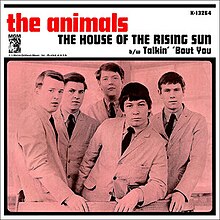 US moving picture sleeve | ||||
| Single by the Animals | ||||
| from the anthology The Animals | ||||
| B-side | "Talkin' 'bout You" | |||
| Released |
| |||
| Recorded | May 18, 1964 | |||
| Genre |
| |||
| Length |
| |||
| Label |
| |||
| Songwriter(s) | Traditional, arr. by Alan Price | |||
| Producer(southward) | Mickie Nigh | |||
| The Animals singles chronology | ||||
| ||||
An interview with Eric Burdon revealed that he beginning heard the song in a club in Newcastle, England, where it was sung by the Northumbrian folk vocalizer Johnny Handle. The Animals were on bout with Chuck Berry and chose it considering they wanted something distinctive to sing.[32] [33]
The Animals had begun featuring their arrangement of "The House of the Ascent Sun" during a joint concert bout with Chuck Berry, using information technology every bit their closing number to differentiate themselves from acts that always closed with straight rockers.[33] [34] It got a tremendous reaction from the audience, disarming initially reluctant producer Mickie Almost that it had hit potential,[34] and between tour stops the group went to a small recording studio on Kingsway in London[34] to capture it.
Recording and releases [edit]
The song was recorded in only one take on May 18, 1964,[35] [36] and information technology starts with a at present-famous electric guitar A minor chord arpeggio by Hilton Valentine.[1] [3] Co-ordinate to Valentine, he merely took Dylan'due south chord sequence and played it as an arpeggio.[37] The functioning takes off with Burdon'due south lead vocal, which has been variously described every bit "howling",[2] "soulful",[38] and equally "...deep and gravelly as the n-east English language coal boondocks of Newcastle that spawned him".[i] Finally, Alan Price'south pulsating organ part (played on a Vox Continental) completes the sound. Burdon later said, "We were looking for a vocal that would catch people'southward attending".[39]
As recorded, "The House of the Rising Sun" ran iv and a one-half minutes, regarded as far too long for a popular single at the time.[35] Producer Most, who initially did not really want to record the song at all,[37] said that on this occasion: "Everything was in the right place ... Information technology only took 15 minutes to make and so I can't accept much credit for the production".[forty] He was nonetheless at present a believer and declared information technology a single at its full length, saying "We're in a microgroove world now, we will release it".[forty]
In the Usa, nonetheless, the original single (MGM 13264) was a two:58 version. The MGM Golden Circle reissue (KGC 179) featured the unedited 4:29 version, although the record characterization gives the edited playing fourth dimension of 2:58. The edited version was included on the group's 1964 Usa debut album The Animals, while the full version was later included on their best-selling 1966 US greatest hits anthology, The Best of the Animals. Still, the very first American release of the total-length version was on a 1965 album of various groups entitled Mickie Nigh Presents British Go-Become (MGM SE-4306), the embrace of which, under the listing of "House of the Ascent Lord's day", described it as the "Original uncut version". Americans could as well hear the complete version in the movie Go Go Mania in the spring of 1965.
Cash Box described the US single version every bit "a haunting, vanquish-ballad updating of the famed folk-blues opus that the grouping's lead delivers in telling solo song fashion."[41]
"House of the Rise Sunday" was not included on whatever of the group's British albums, but information technology was reissued equally a unmarried twice in subsequent decades, charting both times, reaching number 25 in 1972 and number eleven in 1982.
The Animals version was played in vi/8 meter, dissimilar the 4/4 of nigh earlier versions. Arranging credit went just to Alan Price. According to Burdon, this was just because there was insufficient room to proper noun all five band members on the record characterization, and Alan Price's commencement name was first alphabetically. Yet, this meant that only Toll received songwriter'southward royalties for the hit, a fact that has acquired bitterness among the other band members ever since.[3] [42]
Personnel [edit]
- Eric Burdon – vocals
- Hilton Valentine – electrical guitar
- Chas Chandler – bass guitar
- Alan Price – Phonation Continental organ
- John Steel – drums and percussion
Reception [edit]
"House of the Ascension Sun" was a trans-Atlantic striking: after reaching the top of the U.k. popular singles chart in July 1964, it topped the U.s. popular singles chart 2 months later, on September v, 1964, where it stayed for three weeks. Many cite this as the offset truthful classic rock song,[43] and became the first British Invasion number one unconnected with the Beatles.[44] It was the group's quantum hitting in both countries and became their signature song.[45] The song was also a hit in Ireland twice, peaking at No. x upon its initial release in 1964 and later reaching a brand new height of No. 5 when reissued in 1982.
According to John Steel, Bob Dylan told him that when he offset heard the Animals' version on his car radio, he stopped to listen, "jumped out of his car" and "banged on the bonnet" (the hood of the car), inspiring him to go electric.[46] Dave Van Ronk said that the Animals' version—like Dylan's version before it—was based on his arrangement of the song.[47]
Dave Marsh described the Animals' have on "The Business firm of the Rising Lord's day" every bit "the first folk-rock hit", sounding "as if they'd connected the ancient tune to a live wire".[2] Writer Ralph McLean of the BBC agreed that it was "arguably the first folk stone tune" and "a revolutionary single," after which "the face of mod music was changed forever."[three]
The Animals' rendition of the vocal is recognized as one of the classics of British pop music. Writer Lester Bangs labeled it "a brilliant rearrangement" and "a new standard rendition of an old standard composition".[48] It ranked number 122 on Rolling Stone magazine's list of "500 Greatest Songs of All Time". Information technology is also 1 of the Rock and Curl Hall of Fame's "500 Songs That Shaped Stone and Roll". The RIAA ranked it number 240 on their list of "Songs of the Century". In 1999 it received a Grammy Hall of Fame Laurels. It has long since become a staple of oldies and classic rock radio formats. A 2005 Aqueduct 5 poll ranked information technology equally Britain's fourth-favorite number one song.[35]
Charts [edit]
Certifications [edit]
Frijid Pink version [edit]
| "House of the Rising Dominicus" | ||||
|---|---|---|---|---|
 Artwork for Danish, French and German releases (French pressing pictured) | ||||
| Single by Frijid Pinkish | ||||
| from the album Frijid Pink | ||||
| B-side | "Drivin' Blues" | |||
| Released | December 1969 (1969-12) [61] | |||
| Genre |
| |||
| Length |
| |||
| Label | Parrot | |||
| Songwriter(s) |
| |||
| Producer(s) | Michael Valvano | |||
| Frijid Pink singles chronology | ||||
| ||||
In 1969, the Detroit band Frijid Pink recorded a psychedelic version of "House of the Ascension Sunday", which became an international hit in 1970. Their version is in 4/iv time (like Van Ronk's and most earlier versions, rather than the half dozen/8 used by the Animals) and was driven by Gary Ray Thompson's distorted guitar with fuzz and wah-wah furnishings, set against the frenetic drumming of Richard Stevers.[62]
According to Stevers, the Frijid Pink recording of "Business firm of the Rising Sunday" was done impromptu when there was time left over at a recording session booked for the group at the Tera Shirma Recording Studios. Stevers later played snippets from that session'due south tracks for Paul Cannon, the music director of Detroit's premier rock radio station, WKNR; the two knew each other, as Cannon was the father of Stevers'southward girlfriend. Stevers recalled, "we went through the whole thing and [Cannon] didn't say much. So 'Business firm [of the Rising Dominicus]' started upward and I immediately turned information technology off because information technology wasn't annihilation I really wanted him to hear". However, Cannon was intrigued and had Stevers play the complete track for him, and so advising Stevers, "Tell Parrot [Frijid Pinkish's label] to drop "God Gave Me You" [the group's current single] and go with this one".[63]
Frijid Pink'south "Firm of the Ascension Sun" debuted at number 29 on the WKNR hit parade dated January 6, 1970, and broke nationally after some seven weeks—during which the track was re-serviced to radio 3 times—with a number 73 debut on the Hot 100 in Billboard dated February 27, 1970 (number 97 Canada 1970/01/31) with a subsequent three-week ascent to the acme 30 en route to a Hot 100 peak of number seven on April 4, 1970. The certification of the Frijid Pink single "Firm of the Ascent Dominicus" equally a aureate record for domestic sales of one million units was reported in the result of Billboard dated May 30, 1970.
The Frijid Pink unmarried of "Business firm of the Rising Lord's day" would give the song its most widespread international success, with top 10 status reached in Austria (number three), Belgium (Flemish region, number six), Canada (number three), Kingdom of denmark (number iii), Frg (two weeks at number 1), Greece, Ireland (number seven), Israel (number iv), the Netherlands (number three), Norway (7 weeks at number ane), Poland (number 2), Sweden (number six), Switzerland (number two), and the UK (number four). The single also charted in Commonwealth of australia (number fourteen), French republic (number 36), and Italian republic (number 54).
Charts [edit]
Sales and certifications [edit]
Dolly Parton version [edit]
| "The Business firm of the Rising Sun" | ||||
|---|---|---|---|---|
 Artwork for German language release | ||||
| Single by Dolly Parton | ||||
| from the anthology nine to 5 and Odd Jobs | ||||
| A-side | "Working Girl" | |||
| Released | Baronial iii, 1981 (1981-08-03) | |||
| Recorded | November 1980 | |||
| Genre | Country pop | |||
| Length | iv:02 | |||
| Label | RCA | |||
| Songwriter(s) | Traditional | |||
| Producer(s) | Mike Post | |||
| Dolly Parton singles chronology | ||||
| ||||
In August 1981, Dolly Parton released a cover of the song as the third single from her album ix to 5 and Odd Jobs. Similar Miller's before country hit, Parton's remake returns the song to its original lyric of beingness about a fallen adult female. The Parton version makes it quite blunt, with a few new lyric lines that were written by Parton. Parton's remake reached number fourteen on the The states land singles chart and crossed over to the popular charts, where it reached number 77 on the Billboard Hot 100; information technology also reached number thirty on the United states of america Adult Gimmicky nautical chart. Parton has occasionally performed the song live, including on her 1987–88 tv show, in an episode taped in New Orleans.
Five Finger Death Punch version [edit]
| "House of the Rising Sun" | ||||
|---|---|---|---|---|
| Single by Five Finger Death Punch | ||||
| from the album The Incorrect Side of Heaven and the Righteous Side of Hell, Book 2 | ||||
| Released | February iii, 2014 (2014-02-03) | |||
| Recorded | November 2013 | |||
| Genre | Alternative metallic, hard rock, folk rock | |||
| Length | 4:07 | |||
| Characterization | Prospect Park | |||
| Songwriter(s) | Traditional | |||
| Five Finger Decease Punch singles chronology | ||||
| ||||
The American heavy metallic band Five Finger Death Punch released a encompass of "House of the Rising Sun" on their 5th studio album, The Wrong Side of Heaven and the Righteous Side of Hell, Volume 2, which was later released equally the album's second single and the band's tertiary single of the Wrong Side era.[67] The Las Vegas-based band inverse mentions of New Orleans in the lyrics to instead say "Sin Metropolis", equally in the Las Vegas Strip. The song was a top ten hit on mainstream rock radio in the United states of america. It was also featured in the video game Guitar Hero Live.
Other notable versions [edit]
- In 1973, Jody Miller'due south version reached number 29 on the country charts[68] and number 41 on the Adult Gimmicky nautical chart.[69]
- In 1977 Santa Esmeralda scored a top 20 disco hitting with a trip the light fantastic toe version of the song and number 78 on the Hot 100'southward Billboard.[ citation needed ]
Language versions [edit]
Johnny Hallyday version (in French) [edit]
| "Le Pénitencier" | ||||
|---|---|---|---|---|
| Single by Johnny Hallyday | ||||
| from the album Le Pénitencier | ||||
| Released | October 1964 (1964-10) (French republic) | |||
| Recorded | September 1964 | |||
| Characterization | Philips | |||
| Songwriter(s) |
| |||
| Producer(southward) | Lee Hallyday | |||
| Johnny Hallyday singles chronology | ||||
| ||||
| Music video | ||||
| "Le Pénitencier" (Live on French Telly, 1966) "Le Pénitencier" (Alive at the Théâtre de Paris, 2013) on YouTube | ||||
The song was covered in French by Johnny Hallyday. His version (titled "Le Pénitencier", pronounced [lə penitɑ̃sje]) was released in Oct 1964 and spent one week at number one on the singles sales chart in France (from October 17 to 23).[70] In Wallonia, Belgium, his single spent 28 weeks on the chart, as well peaking at number one.[71]
He performed the vocal during his 2014 US bout.
Los Speakers version (in Spanish) [edit]
Colombian band Los Speakers covered the song under the title "La Casa del Sol Naciente", in their 1965 album of the same name.
- Charts
EAV version and 'Wilbert Eckart und seine Volksmusik Stars' versions (in German) [edit]
Ii notable German covers/adaptions were created, one by Erste Allgemeine Verunsicherung, which in 1989 recorded a song with lyrics telling the story of an Eastward Germany citizen fleeing East Berlin afterwards the Fall of the Berlin Wall and his following disillusion with Western order.[73] Some other that gained international recognition was created for the soundtrack of Wolfenstein: The New Order in 2014, interpreting the song with Volksmusik instrumentation, plumbing equipment the alternate future theme of the game in which Nazi Federal republic of germany won World War Two, every bit office of a collection of 'adapted' pop hits.[74] [75]
Possible existent locations [edit]
Diverse places in New Orleans have been proposed as the inspiration for the song, with varying plausibility. The phrase "Firm of the Ascent Sun" is oft understood as a euphemism for a brothel, but it is not known whether the house described in the lyrics was an actual or a fictitious place. One theory is that the song is about a woman who killed her father, an alcoholic gambler who had beaten his wife. Therefore, the Firm of the Rise Sun may be a jailhouse, from which one would be the first person to see the sunrise (an idea supported by the lyric mentioning "a ball and chain", though that phrase has been slang for marital relationships for at to the lowest degree as long as the song has been in print). Considering women often sang the song, another theory is that the House of the Rising Sun was where prostitutes were detained while beingness treated for syphilis. Since cures with mercury were ineffective, going dorsum was very unlikely.[6] [32]

1867 ad noting the "Rise Sun Coffee House" building for hire or lease
Only three candidates that use the proper name Rise Lord's day have historical evidence—from old city directories and newspapers. The first was a pocket-size, brusk-lived hotel on Conti Street in the French Quarter in the 1820s. Information technology burned down in 1822. An excavation and document search in early 2005 found evidence that supported this merits, including an advertisement with language that may accept euphemistically indicated prostitution. Archaeologists constitute an unusually large number of pots of rouge and cosmetics at the site.[76]
The second possibility was a "Ascent Sun Hall" listed in tardily 19th-century city directories on what is now Cherokee Street, at the riverfront in the uptown Carrollton neighborhood, which seems to have been a edifice endemic and used for meetings of a Social Assistance and Pleasure Club, commonly rented out for dances and functions. It also is no longer extant. Definite links to gambling or prostitution (if whatsoever) are undocumented for either of these buildings.
A third was "The Rising Dominicus", which advertised in several local newspapers in the 1860s, located on what is at present the lake side of the 100 block of Decatur Street.[77] In various advertisements it is described every bit a "Eating house", a "Lager Beer Salon", and a "Coffee House". At the time, New Orleans businesses listed as java houses oftentimes also sold alcoholic beverages.
Dave Van Ronk claimed in his biography "The Mayor of MacDougal Street" that at 1 time when he was in New Orleans someone approached him with a number of onetime photos of the city from the turn of the century. Amid them "was a movie of a foreboding stone doorway with a carving on the lintel of a stylized ascension dominicus... Information technology was the Orleans Parish women's prison house".[78]
Bizarre New Orleans, a guidebook on New Orleans, asserts that the real house was at 1614 Esplanade Artery betwixt 1862 and 1874 and was said to have been named afterward its madam, Marianne LeSoleil Levant, whose surname means "the rising sun" in French.[32]
Another guidebook, Offbeat New Orleans, asserts that the existent House of the Ascension Sun was at 826–830 St. Louis St. betwixt 1862 and 1874, also purportedly named for Marianne LeSoleil Levant. The edifice nonetheless stands, and Eric Burdon, after visiting at the behest of the owner, said, "The house was talking to me".[79]
There is a gimmicky B&B called the House of the Rising Sun, decorated in brothel way. The owners are fans of the song, but there is no connectedness with the original identify.[79] [80]
Non anybody believes that the firm actually existed. Pamela D. Arceneaux, a research librarian at the Williams Research Eye in New Orleans, is quoted as saying:
I accept made a written report of the history of prostitution in New Orleans and take often confronted the perennial question, "Where is the House of the Rising Sun?" without finding a satisfactory respond. Although information technology is generally assumed that the singer is referring to a brothel, there is really zippo in the lyrics that indicate that the "house" is a brothel. Many knowledgeable persons have conjectured that a ameliorate example can be made for either a gambling hall or a prison; however, to paraphrase Freud: sometimes lyrics are just lyrics.[6]
References [edit]
Notes
- ^ a b c York, Barry (July 9, 2004). "House of worship". The Historic period . Retrieved January 12, 2014.
- ^ a b c Dave Marsh, The Middle of Rock & Soul: The 1001 Greatest Singles Ever Fabricated, NAL, 1989. Entry #91.
- ^ a b c d McLean, Ralph. "Stories Behind the Song: 'House of the Ascension Sun'". BBC. BBC. Archived from the original on September 8, 2011. Retrieved May 4, 2007.
- ^ Anthony, Ted (2007). Chasing the Rising Dominicus: The Journey of an American Song. Simon & Schuster. p. 21. ISBN9781416539308 . Retrieved February 23, 2016.
- ^ a b c d due east Matteson, Jr., Richard L. (Oct 7, 2010). Bluegrass Picker'southward Tune Book. Mel Bay Music. p. 111. ISBN9781609745523.
- ^ a b c "House of the Ascension Sun - the History and the Song". BBC h2g2. July 28, 2006. Retrieved December 26, 2009.
- ^ a b Harvey, Todd (2001). The Formative Dylan: Transmission and Stylistic Influences 1961–1963. Scarecrow Press. pp. 48–l. ISBN978-0810841154.
- ^ a b Sullivan, Steve (2013). Encyclopedia of Great Popular Song Recordings, Volume ii. Scarecrow Press. pp. 97–98. ISBN9780810882966 . Retrieved February 23, 2016.
- ^ Ward, Simon (April 25, 2016). "Iconic vocal has links to Lowestoft?". Eastern Daily Press . Retrieved August 1, 2021.
- ^ "She Was A Rum One | Lomax Digital Archive". archive.culturalequity.org . Retrieved August 16, 2021.
- ^ "26/04/2016". The One Show. April 26, 2016. BBC.
- ^ a b Anthony, Ted (July xiii, 2007). Chasing the Ascension Sun: The Journey of an American Vocal. Simon and Schuster. pp. 26–27. ISBN978-1-4165-3930-8.
- ^ "New Orleans Legend May Prove to Be Reputable". Los Angeles Times. March 20, 2005. Retrieved August 2, 2021.
- ^ a b Steve Sullivan, Encyclopedia of Great Popular Song Recordings, Book 1, Scarecrow Printing (2013) ISBN 0810882965, 9780810882966, p. 98.
- ^ The same opening lyrics are in the early on recorded version in 1933: Robert B. Flit and David Thou. Engle, "House of the Ascent Sunday, The", The Traditional Ballad Index, 4.0, Fresno State Academy, (2016) (accessed Oct 19, 2016)
- ^ a b c d e "Pete Seeger - American Favorite Ballads" (PDF). Volume ii (pages 11–12). Smithsonian Folkways. 2009. pp. 27–28. Retrieved Dec 4, 2011.
- ^ "House OF THE Rise SUN – Banjo Mountain". Retrieved Nov 29, 2021.
- ^ "Clarence "Tom" Ashley biography". Last.fm . Retrieved July 18, 2021.
- ^ Dixon, Robert G. W.; Godrich, John; Rye, Howard Due west. (1997). Blues & Gospel Records, 1890–1943. Oxford: Oxford University Press.
- ^ "The Ascent Sun Blues · Alan Lomax Kentucky Recordings". lomaxky.omeka.net . Retrieved July 18, 2021.
- ^ "The Rise Sunday Blues · Alan Lomax Kentucky Recordings". lomaxky.omeka.net . Retrieved July 18, 2021.
- ^ Bals, Fred (November 4, 2019). "Chasing the Ascent Sun". Medium . Retrieved July 18, 2021.
- ^ "Alan Lomax Archive". enquiry.culturalequity.org . Retrieved January 13, 2021.
- ^ "Sport in New Orleans | Smithsonian Folkways Recordings". folkways.si.edu . Retrieved October 28, 2021.
- ^ Texas Music magazine Fall, 2016.
- ^ White, Josh. "Business firm Of The Rising Sun". Keynote Records. Retrieved September 18, 2019.
- ^ Holman, Libby. "Firm Of The Ascension Sun". Decca Records. Retrieved September 19, 2019.
- ^ Unterberger, Richie. "This is Tim Hardin". Allmusic. Retrieved February 6, 2017.
- ^ The Mayor of MacDougal Street, ISBN 978-0-306-81479-two, p. 115
- ^ Miller, Michael (June 26, 2013). "'House of the Rising Sunday' to set on Costa Mesa". Los Angeles Times . Retrieved November 22, 2020.
The band'due south 1964 hit "House of the Ascent Sunday," which cast a traditional ballad in a hard, bluesy system, is considered a folk-rock milestone, and hits similar "We Gotta Get Out of This Place" and "Don't Allow Me Be Misunderstood" remain classic rock radio staples.
- ^ Melissa Ursula Dawn Goldsmith (November 22, 2019). Mind to Classic Rock! Exploring a Musical Genre. ABC-CLIO. p. 251. ISBN978-1-4408-6579-iv.
- ^ a b c BBC Radio 4 program January 18, 2008
- ^ a b Gilliland, John (1969). "Prove 29 - The British Are Coming! The British Are Coming!: Kinks, Yardbirds, Stones" (audio). Pop Chronicles. University of North Texas Libraries. Track v.
- ^ a b c Eric Burdon, I Used to Be an Animal, but I'm All Right Now, Faber and Faber, 1986, pp. 60-62.
- ^ a b c Ray Marshall, "The rising of supergroup", Newcastle Evening Chronicle, Baronial 17, 2005. Accessed May v, 2007.
- ^ "Chrome Oxide - Music Collectors pages - Animals - 05/12/2018". www.chromeoxide.com . Retrieved October 24, 2019.
- ^ a b Anthony, Ted (2007). Chasing the Rising Lord's day: The Journey of an American Vocal. Simon & Schuster. p. 146. ISBN9781416539308 . Retrieved February 23, 2016.
- ^ Gina Vivinetto, "More animal magnetism", Saint petersburg Times, January 15, 2004. Accessed May 4, 2007.
- ^ "House of the Ascent Sun". Rolling Stone. 9 December 2004. Archived from the original on 27 April 2007. Retrieved four May 2007.
- ^ a b Jon Kutner, Spencer Leigh, 1000 U.k. Number One Hits, Omnibus Press, 2005.
- ^ "CashBox Record Reviews" (PDF). Cash Box. July 25, 1964. p. 28. Retrieved January 12, 2022.
- ^ Sullivan, S. (2013), Encyclopedia of Nifty Popular Song Recordings, Book 2, Scarecrow Press, ISBN 978-0810882959, p.99.
- ^ Anthony, Ted (2007). Chasing the Rising Dominicus: The Journeying of an American Song. Simon & Schuster. p. 149. ISBN9781416539308 . Retrieved February 23, 2016.
- ^ "The Animals", Rock and Coil Hall of Fame, 1994. Accessed May 4, 2007.
- ^ Muze article, "All-time Of The Animals (Abkco)", Tower Records. Accessed May 4, 2007.
- ^ Anthony, Ted (June nineteen, 2007). Chasing the Rising Sun : The Journey of an American Vocal. Simon & Schuster. p. 151. ISBN9781416539308.
- ^ Van Ronk, Dave. The Mayor of MacDougal Street.
Then, sometime in 1968, Eric Burdon and the Animals made a number-one nautical chart hit out of the damn thing. Same arrangement. I would have loved to sue for royalties, just I institute that it is incommunicable to defend the copyright on an arrangement.
- ^ Lester Bangs, The British Invasion, in The Rolling Stone Illustrated History of Rock & Roll, 1980, p. 176.
- ^ Kent, David (2009). Australian Chart Book: Australian Nautical chart Chronicles (1940–2008). Turramurra: Australian Chart Book. p. 205. ISBN9780646512037.
- ^ "The Animals – The Firm of the Rising Sun" (in Dutch). Ultratop 50.
- ^ "Tiptop RPM Singles: Issue 4715." RPM. Library and Archives Canada.
- ^ "The Animals – The House of the Rising Sunday" (in German). GfK Entertainment charts. Retrieved Feb 27, 2019. To encounter acme nautical chart position, click "TITEL VON The Animals"
- ^ a b "The Irish Charts – Search Results – The House of the Rising Sunday". Irish gaelic Singles Chart.
- ^ "The Animals – The House of the Rising Sunday" (in Dutch). Unmarried Top 100.
- ^ Hung, Steffen. "charts.nz - Forum - 1964 Chart (Full general)". charts.nz . Retrieved Dec 30, 2016.
- ^ a b c "Animals: Artist Chart History". Official Charts Visitor.
- ^ "The Animals Chart History (Hot 100)". Billboard.
- ^ "Danish single certifications – Animals – The House of the Rising Lord's day". IFPI Danmark.
- ^ "Italian unmarried certifications – Animals – The House of the Rising Lord's day" (in Italian). Federazione Industria Musicale Italiana. Retrieved Nov 26, 2020. Select "2018" in the "Anno" drop-down bill of fare. Select "The House of the Rising Sun" in the "Filtra" field. Select "Singoli" nether "Sezione".
- ^ "British single certifications – Animals – The House of the Rising Sun". British Phonographic Industry. Retrieved December 11, 2020.
- ^ "Frijid Pink - House Of The Ascent Sunday". 45cat.com . Retrieved May 30, 2021.
- ^ Frijid Pink entry, Allmusic. Accessed May nineteen, 2007.
- ^ David A. Carson. Grit, Noise, and Revolution: The Birth of Detroit Rock 'n' Roll The Academy of Michigan Press(2009 reprint) p.239
- ^ Kent, David (1993). Australian Nautical chart Book 1970–1992 (illustrated ed.). St Ives, N.S.Westward.: Australian Chart Book. p. 119. ISBN0-646-11917-half-dozen.
- ^ "RPM Top 100 Singles - April 11, 1970" (PDF).
- ^ "American single certifications – Frijid Pink – House of the Rising Lord's day". Recording Manufacture Clan of America.
- ^ Songfacts. "The House Of The Rising Sun past Five Finger Death Punch - Songfacts". www.songfacts.com . Retrieved Nov 29, 2021.
- ^ "Jody Miller". Billboard . Retrieved May 30, 2021.
- ^ "Jody Miller". Billboard . Retrieved May 30, 2021.
- ^ a b "Le pénitencier - Johnny Hallyday - Hit-Parade.net". Retrieved November xiii, 2017.
- ^ "spanishcharts.com - Johnny Hallyday - Le pénitencier". Retrieved Nov 13, 2017.
- ^ "Johnny Hallyday – Le pénitencier" (in French). Ultratop 50.
- ^ "EAV - Es steht ein Haus in Ostberlin". YouTube. Archived from the original on Oct 30, 2021. Retrieved June xiii, 2020.
- ^ "Wolfenstein The New Guild - Haus In Neu Berlin". YouTube. Archived from the original on October 30, 2021. Retrieved June 13, 2020.
- ^ schreef, Cederique (May 17, 2014). "Haus Abendrot: Hitler won the war". Frank G. Bosman (in Dutch). Retrieved June thirteen, 2020.
- ^ "WAS At that place a Firm in New Orleans They Chosen The Ascension Sun?".
- ^ "LEJ's Web log: 10/01/2010 - xi/01/2010". Leonardearljohnson.blogspot.com . Retrieved May thirty, 2021.
- ^ Van Ronk, Dave, and Wald, Elijah, "The Mayor of MacDougal Street" 2005, Da Capo Press, ISBN 978-0-306-82216-2
- ^ a b "In Search of the Firm of the Rise Dominicus". ABC News. Retrieved February 23, 2016.
- ^ "The Song & The Myth". Risingsunbnb.com . Retrieved May thirty, 2021.
External links [edit]
- Songfacts "Business firm of the Ascension Sun" entry
- The sheet music
- The Real Pregnant Backside the Song "Firm of the Rising Sun
- The Ascension Dominicus Dejection: Turner, Georgia, Free Infringe & Streaming: Net Annal
Source: https://en.wikipedia.org/wiki/The_House_of_the_Rising_Sun
0 Response to "Hey Baby You're Hot Like the Rising Sun Lyrics"
Post a Comment